Angelus Thomsen
The Zone of InterestAngelus Thomsen, also known as Golo, is a Nazi officer whose story turns on the split between private feeling and public complicity. A lieutenant and confidant of the camp commandant, he can recognize the brutality of the system he serves, desire Hannah Doll, and form a clandestine connection with a British prisoner—yet he also argues for the camp’s political objectives and helps sustain its machinery. His first-person account records not a clean escape from that contradiction but its persistence: after the war, memory leaves him feeling less like a reformed man than someone unable to assemble a self.
Identity and Position
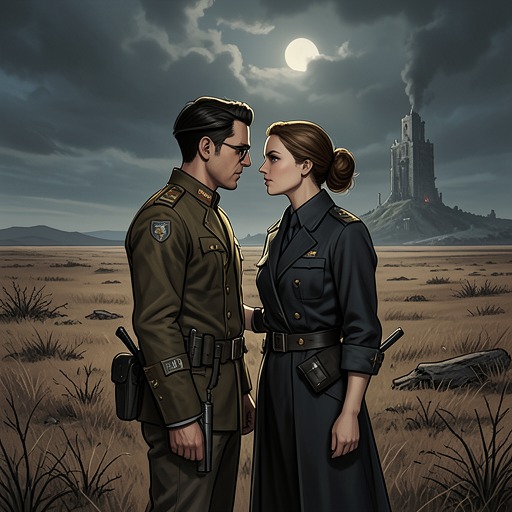
Thomsen presents himself as physically conspicuous and socially assured. He describes his height, pale hair, blue eyes, and imposing build in the same self-conscious inventory with which he measures his attractiveness. That confidence belongs to a man accustomed to privilege: he expects an order from his uncle, Martin Bormann, before acting, and speaks of his connection to the Nazi leadership as a source of authorization. His family access places him inside the regime’s political world even as he serves at a concentration camp.
His formal identity is Lieutenant Angelus Thomsen. When he introduces himself to British Captain Roland Bullard, he does so in English and makes light of his imperfect command of the language. That exchange establishes a distinction that recurs in his story: Thomsen can cross social and linguistic boundaries, but he does so from a position of authority. His charm and fluency do not place him outside the system; they help him move within it.
The narrative’s first-person form makes that tension central. Thomsen does not describe himself as a detached observer of camp violence. He reports his own arguments, rationalizations, and moments of recoil, while his retrospective voice repeatedly exposes discrepancies between what he claims to believe and what his actions sustain. His account is therefore both testimony and self-portrait: it gives access to his doubts, but does not convert those doubts into innocence.
Friendship, Politics, and Complicity
Boris Eltz is Thomsen’s lifelong friend. The two grew up together, from kindergarten through adolescence, and later travelled on cycling holidays in France, England, Scotland, and Ireland, as well as on a three-month journey from Munich to Reggio and onward to Sicily. Thomsen remembers Boris as emphatic, intrepid, and handsome, a permanent presence in his life. He also marks the point when their friendship became difficult: politics, and history itself, had come down upon them.
Boris’s doubts about the regime have a concrete origin. At Goleschau, he heard that psychiatric patients were being killed in Königsberg to free hospital beds for men who had broken down while killing women and children in Poland and Russia. He describes this discovery as an anti-revelation: not a sudden conversion so much as the recognition that the state was profoundly wrong. His story of Bohdan, who sat by a door expecting the authorities to come for him and had already given away his belongings, gives that realization a human consequence. The friendship remains intimate, but the two men no longer inhabit the same moral understanding of their world.
Thomsen, meanwhile, demonstrates how political language enables his participation. In a discussion about increasing workers’ strength by twenty per cent and making them last longer, he insists that the camp’s political objective must not be lost among commercial and industrial considerations. He invokes agreement with the head of the SS and rejects what he calls pampering. The language presents cruelty as discipline and political necessity, not as a personal choice. It also reveals that Thomsen is not merely carried along by other people’s decisions: he argues for the policy and lends it his authority.
His handling of antisemitic propaganda offers another example of self-exculpatory reasoning. Thomsen says that he has banned Der Stürmer in the camp because its lurid depictions of Jewish men damage the cause of serious antisemitism, which he claims should rest on charts, statistics, and scientific evidence. He recalls a display of the newspaper at Dachau that provoked violence among prisoners, then shifts blame onto Jewish prisoners and their supposed bribery and influence. His objection is not to antisemitism but to a form of propaganda he considers counterproductive. The episode exposes the distance between his professed preference for method and the violence his ideology legitimizes.
At Spring Meadow, the gap between his self-image and his conduct becomes sharper. Thomsen describes hearing and smelling the cremation field, where the sounds of burning carry across the distance. He then insists that he is a normal man with normal feelings and explains that thoughts of Germany and the trust placed in him by its leader suppress human weakness. He recasts kindness to Jewish people as cruelty to Germans and replaces moral distinctions with a calculation of positive and negative outcomes. The more plainly the scene presents the consequences of his work, the more insistently he tries to make moral judgment seem obsolete.
Hannah Doll and the Possibility of Intimacy
Thomsen’s account of Hannah Doll begins in the language of sudden transformation. Speaking to Boris in the Officers’ Club, he recalls that something happened at first sight and says that, for a moment, he felt young again and experienced something like love. The setting—horsehair furniture, horse brass and prints, and ersatz coffee—belongs to the officers’ world around them, while his description makes the encounter feel like an interruption of that world’s routines.
Boris immediately challenges the practical possibility of a relationship. Thomsen will be leaving by Christmas, Boris says, while he expects to remain until June; Hannah is too conspicuous, and her husband is not merely an old drunk but the commandant. The warning identifies the personal danger built into Thomsen’s desire. Hannah is not simply a romantic possibility: she is the commandant’s wife, and the commandant’s power governs the place where Thomsen serves. Thomsen answers with little more than the hope that stranger things have happened, leaving the attraction alive without resolving its risks.
His attachment develops alongside knowledge of the camp’s losses. At the riding school, he passes Hannah a message reporting that Dov Cohn, a prisoner associated with Professor Szozeck, has also been transferred, along with a kapo who had taken an interest in him and might have been his confidant. Thomsen emphasizes that he learned of the transfer six weeks after it happened and had believed Dov well equipped to survive. The message makes their connection a channel for shared knowledge of prisoner deaths and disappearances, rather than an escape from the surrounding reality.
A later memory of watching Hannah sleep in a half-built pavilion gives the relationship its strongest inward consequence. Over the sixty or seventy minutes, Thomsen feels that something in him has shifted. He recognizes what he has relinquished and sees his heart as soiled and shrunken; when Hannah opens her eyes, he experiences something like hope. He describes himself as beginning again from nothing, newly alert to ordinary things he had taken for granted. That awakening is not presented as moral repair. Even in the same reflection, he sees lines of prisoners returning to slavery while a band plays, and the renewed capacity to notice the world exists beside his continuing place within the system that degrades it.
Actions, Doubt, and the War
Thomsen’s dealings with Roland Bullard join curiosity to clandestine action. On the last day of November, he follows Bullard into a tool cabin between the prisoner compounds, where components of a dismantled welding gun lie arranged on a pillowslip. Thomsen brings him cigarettes and uses the British patriotic song Rule Britannia to signal that he has understood Bullard’s activity. He tells Bullard that he has been watching him and has seen him bend the blades of a cooling fan in the Polymerisation Bureau. Bullard’s sabotage is real; Thomsen’s approach makes clear that he has chosen to acknowledge and encourage it rather than report it. The evidence establishes a covert understanding, even as it leaves the full scope of their cooperation unspecified.
His official work pulls him in the opposite direction. In Berlin, he spends several pages on the cosmic-ice theory and a few minutes examining the racial-cultural work of the Ahnenerbe before deciding that his business in the capital is finished. He is desperate to return to the camp, but his impatience is not primarily about Hannah: it concerns the pace of the Buna-Werke and the war. An appointment with Bormann keeps him waiting through repeated arrangements and cancellations. When he finally presents his report, he calls his conclusion open and shut; the theory he summarizes imagines the Nordic peoples as preserved from the earliest ages and uses that fantasy to distinguish them from supposedly inferior races. Thomsen can dissect the absurdity of an ideological construction, yet he remains an official charged with serving the regime that uses such claims.
The war’s failing prospects expose the consequences of his administrative role. Thomsen tells Konrad Peters that Grofaz and Rupprecht Strunck have shown him to be a desk perpetrator—a murderer at a writing table—and that his work has been for nothing. Peters counters that Buna and synthetic fuel could not win the war but might prolong it. Thomsen’s distress, then, is not simply that the policy has failed or that he has been wrongly accused. He recognizes that his desk-bound work has had a murderous purpose, while still measuring its significance partly by whether it could have extended the war.
His eastward journey makes the ideology of racial hierarchy tangible through its restrictions. Thomsen notes that Poles cannot travel on ordinary trains without special permits and are excluded from public transport and cultural institutions; they are also barred from owning or using a long list of ordinary goods. He records the regime’s permission for ethnic Germans to kill Poles and places Poles within an imposed hierarchy that treats Jews, Soviet prisoners of war, and Roma and Sinti as lower still. The description exposes the violence of the order he serves, but his own journey remains privileged: he has a private train compartment and two berths to choose from. Even these comforts have become nauseating to him, and the grime coating the train’s interior seems to confirm that Germany and the war are already lost. He nevertheless intends to return to the camp for Walpurgis Night.
Breakdown and Afterlife
A recurring crisis in Thomsen’s account comes into focus after the Reich Day of Mourning. He wakes in the Officers’ Club after a patriotic luncheon and finds the room marked by the remains of a drunken banquet: discarded napkins, toppled bottles, and cigarette ends in the trifle. From there, questions he has avoided press in on him. He asks why work he calls good smells so bad, why officers drink brutally after arrivals at the ramp, why the meadow was made to churn and spit, and why conception in the camp promises death to both mother and child. The questions gather physical evidence—flies, vermin, disease, and brown snow—against the abstract language of duty and political goals.
Thomsen’s reflection on obedience follows the same reversal. He notices the motto on the office wall that equates loyalty with honour and considers the corpse embedded in the German word for ideal obedience. At the camp, the dead are in the crematoria and pits, but he understands that those who obey are also spiritually dead. The realization is acute, but it does not erase his prior actions or establish a decisive break. Instead, it shows him recognizing the likeness between the victims’ physical destruction and the moral numbness he has cultivated in himself.
In September 1948, Thomsen drives southeast in a filthy old Tornax, hoping to approach the end of hope and exhaust it. He is older and greyer, works as a translator for the American occupation government, and has friends and acquaintances and a plausible public routine. Yet he cannot construct a plausible inner life. He describes himself during the camp years as doubled, divided between the person he was and another self; after the war he feels halved. His memories of Hannah do not seem like a story interrupted before its ending, but one that scarcely began. He recalls her stance, the way she held a glass and crossed a room, while also remembering that their encounters unfolded amid the camp’s misery and stench. The intimacy he treasured cannot be separated from the place and power structure that surrounded it.
A later conversation with Hannah gives that unresolved history a further, disturbing edge. She recounts that she saw Szmul look her in the eye, and remembers Doll covered in blood, still trying to smile. She says she took the girls to Romhilde Seedig’s and left as soon as she could. Looking back, she suspects that Doll had persuaded Szmul to hurt or even kill her, and she identifies Doll’s preventing Szmul from killing himself as the worst part of what followed: instead, he destroyed Szmul’s face. Thomsen does not claim certainty for her; he answers that she has had five years to think and must have reached some understanding. The scene places him once more beside Hannah, listening to a history he cannot undo. His final condition is not a settled redemption or a completed romance, but continued proximity to memory—and the knowledge that his private tenderness never made him innocent of the world in which it took shape.